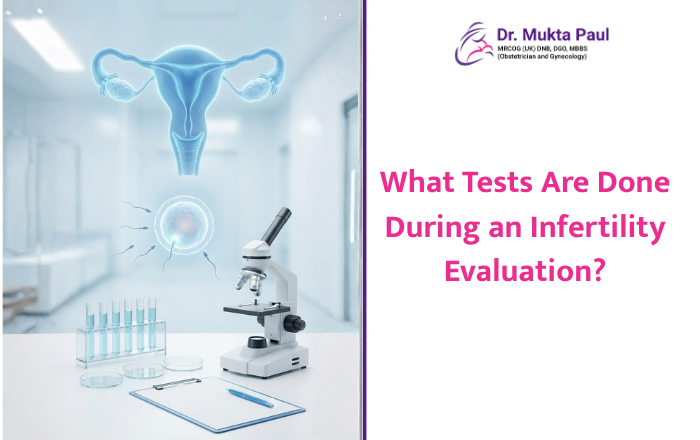
Trying to conceive can be an emotional journey, especially when pregnancy does not happen despite regular attempts. One of the first steps in understanding the situation is an infertility evaluation. The purpose of fertility testing is not simply to find “what is wrong,” but to understand how ovulation, the uterus, fallopian tubes, sperm, hormones, and other factors may be affecting the chances of pregnancy.
Importantly, infertility evaluation is usually done for both partners, because fertility problems can involve the female partner, male partner, both, or sometimes no clearly identifiable cause.
This guide explains the common infertility tests for women and men, what each test checks, and when these tests may be recommended.
The right time to seek an evaluation depends partly on age and medical history.
Generally:
You do not necessarily need to wait for these time periods if there is already a reason to suspect a fertility problem.
A fertility evaluation generally includes three important areas:
Depending on the individual situation, doctors may recommend blood tests, ultrasound, semen analysis, tubal tests, or other investigations. Not everyone needs every available fertility test.
Before ordering tests, a doctor will usually ask detailed questions about your health and reproductive history.
This may include:
For men, the discussion may include previous testicular problems, surgeries, infections, medications, sexual difficulties and other health conditions.
This history can sometimes provide important clues before any laboratory test is performed.
Female fertility testing focuses mainly on ovulation, ovarian function, the uterus and the fallopian tubes.
Ovulation means the release of an egg from the ovary. If ovulation does not happen regularly, getting pregnant can become difficult.
The doctor may assess ovulation through:
Women with consistently regular menstrual cycles between approximately 21 and 35 days may already have a history suggesting regular ovulation, so additional ovulation testing is not always necessary.
A progesterone test can help confirm whether ovulation has occurred.
It is generally taken at an appropriate point in the second half of the menstrual cycle, usually about a week before the expected period rather than automatically on a particular cycle day.
Depending on symptoms and medical history, blood tests may be recommended to look for hormonal factors affecting fertility.
These may include:
It is important to understand that more hormone tests do not automatically mean a better fertility evaluation. Doctors usually select tests based on the person’s cycle pattern, symptoms, age and medical history.
Anti-Müllerian hormone (AMH) is commonly used as one measure of ovarian reserve.
Other methods may include:
However, ovarian reserve is not the same as overall fertility.
A person may have a particular AMH level and still have other fertility factors that need to be assessed. Ovarian reserve tests are mainly useful as part of an infertility evaluation and for helping plan fertility treatment; they should not be interpreted as a simple “fertility score.”
A transvaginal ultrasound is one of the commonly used imaging tests during fertility evaluation.
It can help the doctor examine:
It can also be used during the menstrual cycle to monitor follicular development and ovulation.
Ultrasound findings can help determine whether additional testing is necessary.
A hysterosalpingogram (HSG) is an imaging procedure used to check the inside of the uterus and whether the fallopian tubes are open.
Why does this matter?
For natural conception, sperm needs to reach the egg and the fertilized egg needs to travel through the fallopian tube toward the uterus. Blocked or damaged tubes can interfere with this process.
During an HSG:
HSG is one of the commonly recommended methods for evaluating tubal patency.
A sonohysterography uses ultrasound after sterile fluid is introduced into the uterus.
It can provide a clearer view of the inside of the uterine cavity and may help identify certain abnormalities.
Depending on the situation, a doctor may also recommend:
A thin camera is passed through the cervix to directly examine the inside of the uterus.
It may help identify problems such as certain:
Laparoscopy involves inserting a camera through a small abdominal incision. It can provide information about the outside of the uterus, ovaries and fallopian tubes.
However, laparoscopy is not routinely required for every infertility evaluation. It is generally considered when there is a specific reason to suspect conditions such as endometriosis or pelvic adhesions, or when surgery is otherwise indicated.
Fertility evaluation should not focus only on the woman. Male factors can also contribute to difficulty conceiving.
A semen analysis is one of the most important initial tests for male fertility.
It evaluates characteristics such as:
The results can help determine whether sperm-related factors may be contributing to difficulty conceiving.
If the first result is abnormal, the doctor may recommend repeat testing or additional evaluation rather than making a conclusion from a single result.
Blood tests may sometimes be used to measure male reproductive hormones.
These may be recommended when there are concerns about:
Depending on the findings, further evaluation by an appropriate specialist may be recommended.
No.
One common misconception is that a complete fertility evaluation means undergoing every possible test. In reality, testing should be step-by-step and based on the couple’s medical history and initial results.
For example:
This approach can help avoid unnecessary procedures, expenses and anxiety.
Once the initial evaluation is complete, the doctor reviews the results together rather than looking at one number in isolation.
Depending on the findings, the next step may involve:
Sometimes all routine tests appear normal. This is commonly referred to as unexplained infertility. Even in such cases, treatment options may still be available.
1. What is the first test for infertility?
There is no single test that is first for everyone. A medical and menstrual history is usually the starting point, followed by appropriate testing. For the male partner, semen analysis is an important initial investigation.
2. How is female infertility diagnosed?
Female infertility evaluation may involve menstrual and ovulation assessment, blood tests, ovarian reserve assessment, ultrasound and tests to examine the uterus and fallopian tubes. The exact combination depends on the individual situation.
3. Is AMH enough to check fertility?
No. AMH is a marker of ovarian reserve, but it does not provide a complete picture of fertility. Age, ovulation, fallopian tube status, uterine factors and sperm factors may also matter.
Have questions? We’re just a message away! Contact us on WhatsApp — Click Here to Chat with Us
If you are looking for guidance about fertility testing or have been trying to conceive without success, discussing your situation with an experienced obstetrician and gynecologist can be a useful first step.
Dr. Mukta Paul, Senior Obstetrician and Gynecologist with 22+ years of experience, provides gynecological and fertility-related consultation at Hridan Specialist Clinic, Kharadi, Pune. She holds MBBS, DGO, DNB and MRCOG (UK) qualifications.
She can help assess your medical and reproductive history, determine which infertility tests may actually be appropriate, and guide you through the next steps based on your individual situation.
Clinic: Hridan Specialist Clinic
Address: Shop No. 1, Vitthal Heights, Mundwa–Kharadi Road, opposite Radisson Blu Hotel, Kharadi, Pune
If you are concerned about difficulty conceiving, it is worth discussing your situation rather than simply ordering multiple fertility tests on your own. A structured evaluation can help identify the relevant factors and avoid unnecessary investigations.
Copyright © 2026 All Rights Reserved Website Design By DMXDIGITAL
WhatsApp us